
IGF-1LR3

Price range: $125.00 through $200.00
YOUR ORDER COMES WITH;
-
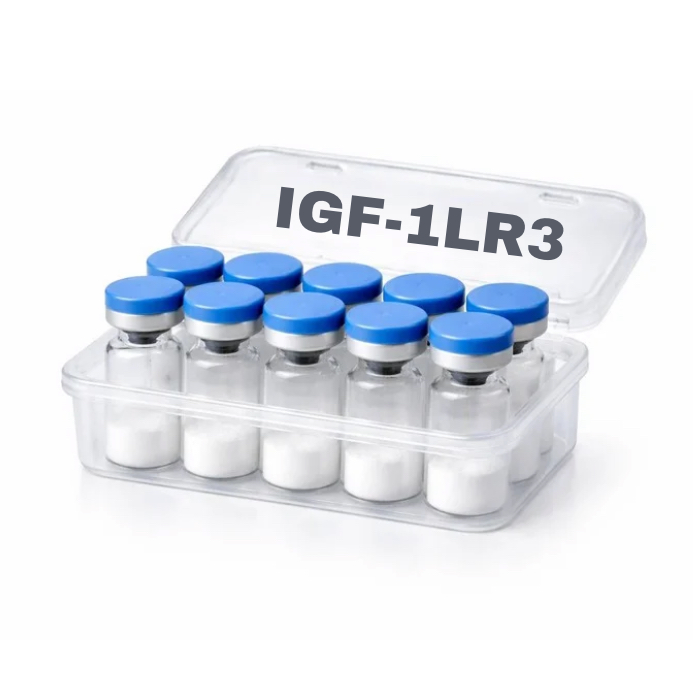
10 VIALS x 1mg of IGF-1 LR3 Research Peptide
-
FREE: Bacteriostatic Water (30ml), Sterile Syringes (1ml, 29G), and Alcohol Swabs
-
DOSING SCHEDULE: Comprehensive laboratory administration protocol for research models
-
USAGE INSTRUCTIONS: Detailed reconstitution guide, stability parameters, and handling procedures for this potent growth factor
-
A COPY OF LAB RESULTS: Certificate of Analysis (CoA) confirming purity, sequence, and sterility
IGF-1 LR3 is a modified analog of Insulin-like Growth Factor-1 with an extended R3 chain and altered sequence for reduced binding protein affinity, supplied for research into potentiated anabolic signaling, cellular proliferation, and glucose metabolism. This complete research kit includes all necessary components for standardized experimental studies in growth factor biology.
Enhanced IGF-1 Analog for Potent Growth Factor Research
IGF-1 LR3 (Long R3 Insulin-like Growth Factor-1) is an 83-amino acid analog of human IGF-1, comprising the complete 70-amino acid IGF-1 sequence with a 13-amino acid extension peptide at the N-terminus (hence “Long R3”) and an arginine (R) substitution for glutamic acid (E) at position 3. These modifications confer two key research advantages: 1) dramatically reduced affinity for IGF-binding proteins (IGFBPs), increasing bioavailability and potency in experimental systems, and 2) prolonged in-vivo half-life. In research settings, IGF-1 LR3 serves as a powerful tool for investigating the direct effects of potent IGF-1 receptor activation on myoblast differentiation, muscle protein synthesis, chondrocyte and osteoblast activity, neuronal survival, and cellular glucose uptake, with minimal interference from endogenous binding proteins. Supplied as a lyophilized powder, this research-grade growth factor analog is intended strictly for controlled, non-human laboratory studies exploring maximized anabolic signaling, tissue repair, and metabolic regulation.
Complete Research Kit Contents & Verification
Each research order provides a complete experimental package designed for growth factor research:
-
Primary Research Compound: 10 sterile glass vials containing 1mg of lyophilized IGF-1 LR3 peptide powder per vial. Note: 1mg is a standard, potent research quantity for this compound.
-
Reconstitution Solution: 30ml vial of sterile Bacteriostatic Water (0.9% Benzyl Alcohol) with 0.1M Acetic Acid or specified acidic buffer. CRITICAL: IGF-1 LR3 requires reconstitution in a slightly acidic solution (pH ~4-5) to prevent aggregation and maintain stability. Standard bacteriostatic water may not be suitable alone; an acidic diluent is typically provided or specified.
-
Laboratory Administration Tools: Pack of sterile 1ml insulin syringes (29G x 1/2″) for precise measurement and transfer.
-
Sterilization Supplies: Individually wrapped alcohol prep swabs.
-
Research Protocol Documentation:
-
Dosing Schedule: Administration protocol for research models, noting the increased potency and longer half-life compared to native IGF-1.
-
Usage INSTRUCTIONS (CRITICAL): Detailed guide focusing on the unique handling requirements: reconstitution in the correct acidic vehicle, avoidance of neutral pH, storage at -20°C to -80°C, use of low-protein-binding tubes, and prevention of repeated freeze-thaw cycles to avoid precipitation and loss.
-
-
Quality Verification: Certificate of Analysis (CoA) provided with each batch, detailing:
-
Purity Analysis (>97% by HPLC – challenging due to size and modifications)
-
Structural Verification (Mass Spectrometry):
-
Confirmation of full 83-amino acid sequence
-
Verification of N-terminal 13-amino acid extension
-
Confirmation of Arg³ substitution (E3R)
-
-
Molecular Weight: ~9112 Da Confirmed
-
Bioactivity/Potency Assay (Cell proliferation assay, e.g., in MCF-7 cells)
-
Sterility Testing
-
Endotoxin Levels (<1.0 EU/µg – stringent due to protein nature)
-
Aggregation Analysis (by SEC-HPLC)
-
Correct Folding Verification (Disulfide bond pattern)
-
Research Applications & Scientific Utility
In a laboratory setting, IGF-1 LR3 enables investigation into potent, unbound IGF-1 receptor signaling. Primary research applications include:
-
Skeletal Muscle Biology: Studying hyper-potent stimulation of myoblast proliferation, differentiation, and muscle fiber hypertrophy in vitro and in muscle injury/atrophy models.
-
Cartilage & Bone Research: Investigating effects on chondrocyte and osteoblast activity in models of osteoarthritis, fracture healing, or osteoporosis.
-
Metabolic Studies: Researching enhanced glucose uptake in myocytes and adipocytes, and its interplay with insulin signaling.
-
Tissue Engineering: Utilizing as a potent growth factor in bioreactors for cultivating muscle, cartilage, or other IGF-responsive tissues.
-
Comparative Studies: Serving as a high-potency comparator to native IGF-1 or other IGF variants to isolate the effects of binding protein interaction.
Laboratory Handling & Safety Protocol – EXTREME PRECAUTION
-
Storage: Store unopened vials at -80°C. This is a large, delicate protein. Reconstituted solutions must be aliquoted, stored at -80°C, and never refrozen after thawing. Use a single aliquot per experiment.
-
Reconstitution: Must use the provided acidic diluent (e.g., 0.1M acetic acid). Do not use plain bacteriostatic water. Gently swirl to dissolve. Do not vortex. The solution should be clear.
-
Stability: The compound is unstable at neutral pH and will precipitate. For in-vivo research, buffer must be adjusted appropriately post-reconstitution for physiological compatibility, which is a complex research step.
-
Laboratory Safety: Standard PPE required. Handle as a potent, bioactive growth factor with mitogenic potential. Use appropriate containment.
⚠️ Critical Compliance & Intended Use Disclaimer:
THIS PRODUCT IS SOLD FOR RESEARCH USE ONLY (RUO). NOT FOR HUMAN OR VETERINARY DIAGNOSTIC OR THERAPEUTIC USE.
-
Intended Use: IGF-1 LR3 is supplied as a potent biochemical reagent for laboratory research purposes only. It is intended for use by qualified researchers in controlled non-human settings. The “dosing schedule” is for research models only.
-
Not for Human Consumption: Under ABSOLUTELY NO CIRCUMSTANCES is this product intended for human or animal administration. It is a potent growth factor with mitogenic and potentially carcinogenic risks. It is not a performance-enhancing or muscle-building drug.
-
Regulatory Status: This product has not been evaluated or approved by any health authority. It is an investigational research compound with significant known risks.
-
Handling Risk: The researcher assumes all risk for handling this biologically active protein, including potential self-exposure risks.
-
Researcher Responsibility: The purchaser is solely responsible for compliance with all laws and biosafety regulations, particularly those governing the use of potent growth factors.
| QUANTITY | 0.5MG, 1MG |
|---|
Be the first to review “IGF-1LR3”
Related products
Peptides
Peptides
Peptides
Peptides
Peptides
Peptides
Peptides
Peptides
Reviews
There are no reviews yet.