
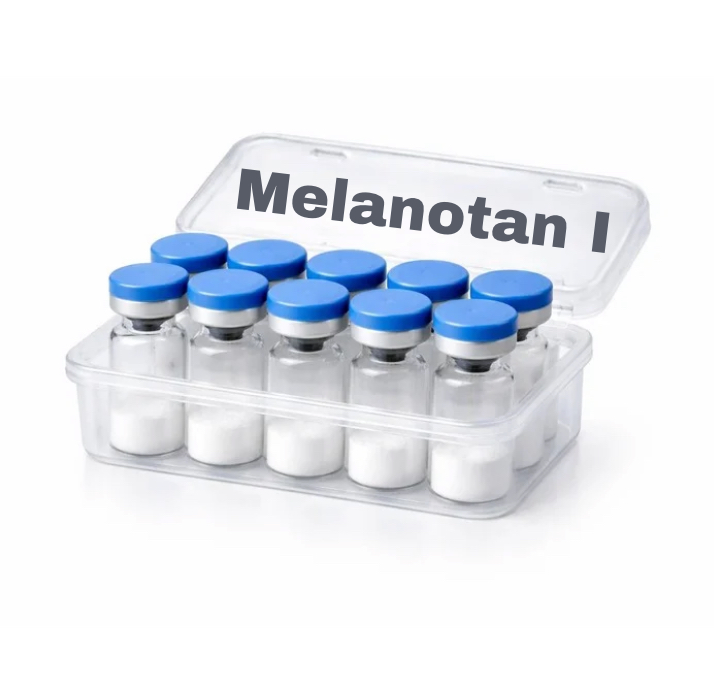
Melanotan I 10mg

$100.00
YOUR ORDER COMES WITH;
-
10 VIALS x 10mg of Melanotan I (Afamelanotide) Research Peptide
-
FREE: Bacteriostatic Water (30ml), Sterile Syringes (1ml, 29G), and Alcohol Swabs
-
DOSING SCHEDULE: Comprehensive laboratory administration protocol for research models
-
USAGE INSTRUCTIONS: Detailed reconstitution guide, storage parameters, and handling procedures
-
A COPY OF LAB RESULTS: Certificate of Analysis (CoA) confirming purity, sequence, and sterility
Melanotan I is a synthetic 13-amino acid analog of α-melanocyte-stimulating hormone (α-MSH) designed for research into melanogenesis, skin pigmentation, and photoprotection mechanisms without UV exposure. This complete research kit includes all necessary components for standardized experimental studies in dermatology and pigment biology.
Linear α-MSH Analog for Melanocortin Receptor & Pigmentation Research
Melanotan I (also known by its INN Afamelanotide) is a synthetic, linear 13-amino acid peptide (sequence: Ac-Ser-Tyr-Ser-Nle-Glu-His-D-Phe-Arg-Trp-Gly-Lys-Pro-Val-NH₂) that functions as a potent analog of α-melanocyte-stimulating hormone (α-MSH). Its structure incorporates a norleucine (Nle) substitution at position 4 for enhanced metabolic stability and a D-phenylalanine at position 7 to increase receptor affinity and resistance to enzymatic degradation. In research settings, Melanotan I serves as a selective agonist primarily at the melanocortin-1 receptor (MC1R) on epidermal melanocytes, making it a valuable tool for investigating UV-independent melanogenesis (eumelanin production), skin photoprotection mechanisms, and the broader role of MC1R signaling in inflammation and DNA repair. Unlike its cyclic counterpart Melanotan II, Melanotan I exhibits greater receptor selectivity with minimal off-target effects on other melanocortin receptors (e.g., MC3R, MC4R), allowing for more focused research. Supplied as a lyophilized powder, this research-grade peptide is intended strictly for controlled, non-human laboratory studies exploring pigment biology and dermatological science.
Complete Research Kit Contents & Verification
Each research order provides a complete experimental package designed for pigment biology research:
-
Primary Research Compound: 10 sterile glass vials containing 10mg of lyophilized Melanotan I peptide powder per vial.
-
Reconstitution Solution: 30ml vial of sterile Bacteriostatic Water (0.9% Benzyl Alcohol) for experimental use.
-
Laboratory Administration Tools: Pack of sterile 1ml insulin syringes (29G x 1/2″) for precise measurement and transfer.
-
Sterilization Supplies: Individually wrapped alcohol prep swabs.
-
Research Protocol Documentation:
-
Dosing Schedule: Standardized administration protocol for research models focusing on melanogenesis studies, photoprotection assays, and chronic dosing regimens relevant to pigment induction.
-
Usage Instructions: Comprehensive guide covering reconstitution, storage conditions (-20°C recommended), handling safety, and experimental design considerations for topical vs. systemic administration models in skin research.
-
-
Quality Verification: Certificate of Analysis (CoA) provided with each batch, detailing:
-
Purity Analysis (>98% by HPLC)
-
Structural Verification (Mass Spectrometry):
-
Full 13-amino acid sequence confirmation
-
Critical: Confirmation of Norleucine (Nle) at position 4 and D-Phenylalanine at position 7
-
Verification of N-terminal Acetylation and C-terminal Amidation
-
-
Molecular Weight: 1646.9 Da Confirmed
-
Sterility Testing Results
-
Endotoxin Levels (<10 EU/mg)
-
Residual Solvent Analysis
-
Net Peptide Content
-
Selectivity Note: While not a direct assay on the CoA, the product description should note its research profile as a selective MC1R agonist.
-
Research Applications & Scientific Utility
In a laboratory setting, Melanotan I enables specific investigation into MC1R-mediated pathways. Primary research applications include:
-
Melanogenesis Research: Studying the upregulation of tyrosinase activity, eumelanin synthesis, and melanosome transfer to keratinocytes in melanocyte co-culture or skin equivalent models without UV stimulation.
-
Photoprotection Studies: Investigating the potential protective role of increased eumelanin against UV-induced DNA damage, oxidative stress, and apoptosis in skin models.
-
Pigment Disorder Models: Researching therapeutic mechanisms in models of vitiligo, erythropoietic protoporphyria (EPP – its approved clinical indication), or other photosensitivity disorders.
-
Receptor Selectivity Studies: Serving as a selective tool to isolate MC1R effects from those of other melanocortin receptors (MC3-5R) in comparative studies with non-selective agonists like Melanotan II.
-
Dermatopharmacology: Exploring local vs. systemic effects on pigmentation and skin physiology.
Laboratory Handling & Safety Protocol
-
Storage: Store unopened lyophilized peptide vials at -20°C or below. Reconstituted solutions should be aliquoted and stored at -20°C. Protect from light during handling and storage, as with all peptides involved in photobiology research.
-
Reconstitution: Perform under sterile conditions. The peptide dissolves readily in bacteriostatic water. Swirl gently.
-
Laboratory Safety: Standard PPE is required. For research involving UV light, follow appropriate light source safety protocols.
-
Pigmentation Note: Researchers working with live animal models should be aware that this peptide induces robust, long-lasting skin and coat darkening, which is a key phenotypic readout but also a permanent change in the animal.
⚠️ Critical Compliance & Intended Use Disclaimer:
THIS PRODUCT IS SOLD FOR RESEARCH USE ONLY (RUO). NOT FOR HUMAN OR VETERINARY DIAGNOSTIC OR THERAPEUTIC USE.
-
Intended Use: Melanotan I is supplied as a biochemical reagent for laboratory research purposes only. It is intended for use by qualified researchers in controlled settings studying pigment biology and dermatology. The “dosing schedule” is for research models only.
-
Not for Human Consumption: Under NO CIRCUMSTANCES is this product intended for human administration. It is not a tanning agent, cosmetic, or treatment for any skin condition. Its distribution for human use is illegal in many countries. The provided supplies are for laboratory use.
-
Regulatory Status: This product has not been manufactured or approved for human use. While a pharmaceutical version (Scenesse®) exists for a rare condition, THIS SPECIFIC PRODUCT IS NOT THAT DRUG.
-
Specific Warning: Melanotan peptides have a well-documented history of misuse in illicit “tanning” markets. This product is supplied exclusively to counteract that market by providing a verified, pure standard for legitimate research that studies the risks and mechanisms of such compounds.
-
Researcher Responsibility: The purchaser assumes full responsibility for compliance with all laws and for ensuring this compound is used exclusively for legitimate, non-human research, with appropriate ethical approvals for animal studies involving pigmentation changes.
Be the first to review “Melanotan I 10mg”
Related products
Peptides
Peptides
Peptides
Peptides
Peptides
Peptides
Peptides
Peptides
Reviews
There are no reviews yet.