
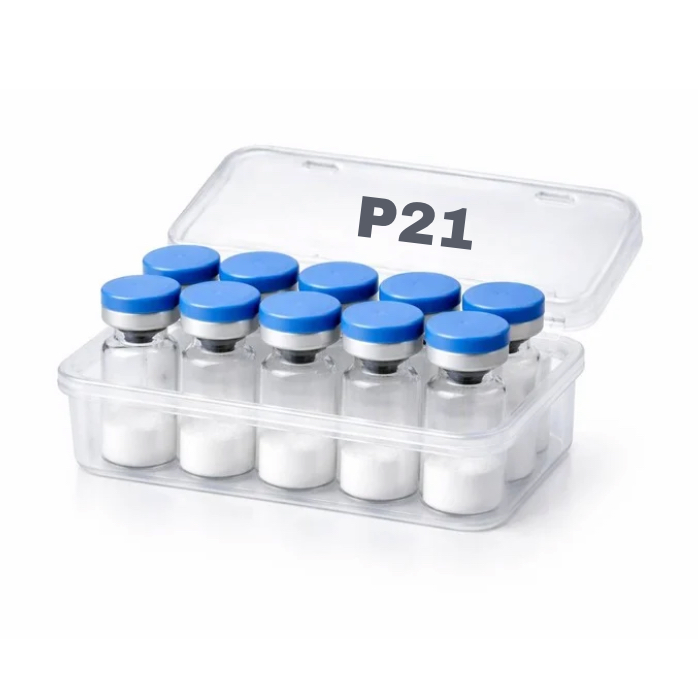
P21 (PO21) 5mg

$425.00
YOUR ORDER COMES WITH;
-
10 VIALS x 5mg of P21 Research Peptide
-
FREE: Bacteriostatic Water (30ml), Sterile Syringes (1ml, 29G), and Alcohol Swabs
-
DOSING SCHEDULE: Comprehensive laboratory administration protocol for research models
-
USAGE INSTRUCTIONS: Detailed reconstitution guide, storage parameters, and handling procedures
-
A COPY OF LAB RESULTS: Certificate of Analysis (CoA) confirming purity, sequence, and sterility
P21 is a synthetic 11-amino acid peptide (sequence: LVGRTLRGLPY) modeled on an active fragment of Cerebrolysin, supplied for research into neurogenesis, synaptic enhancement, and cognitive recovery pathways. This complete research kit includes all necessary components for standardized experimental studies in neuroscience.
Cerebrolysin-Derived Peptide for Neurotrophic & Cognitive Research
P21 is a synthetic peptide comprising 11 amino acids (Leu-Val-Gly-Arg-Thr-Leu-Arg-Gly-Leu-Pro-Tyr) that corresponds to an active subfragment identified within the complex porcine brain-derived peptide preparation, Cerebrolysin. This peptide was designed to isolate and study a specific component responsible for some of the neurotrophic and neuroprotective effects observed with the parent compound. In research settings, P21 serves as a focused tool for investigating mechanisms of neuronal survival, neurite outgrowth, synaptogenesis, and cognitive enhancement without the complexity of the full multi-peptide mixture. It is believed to act through modulation of neurotrophic factor expression (particularly BDNF – Brain-Derived Neurotrophic Factor) and downstream signaling pathways like PI3K/Akt and MAPK/ERK. Supplied as a lyophilized powder, this research-grade peptide is intended strictly for controlled, non-human laboratory studies exploring targeted approaches to neurodegenerative diseases, cognitive disorders, and brain repair mechanisms.
Complete Research Kit Contents & Verification
Each research order provides a complete experimental package designed for neuroscience research:
-
Primary Research Compound: 10 sterile glass vials containing 5mg of lyophilized P21 peptide powder per vial.
-
Reconstitution Solution: 30ml vial of sterile Bacteriostatic Water (0.9% Benzyl Alcohol) for experimental use.
-
Laboratory Administration Tools: Pack of sterile 1ml insulin syringes (29G x 1/2″) for precise measurement and transfer.
-
Sterilization Supplies: Individually wrapped alcohol prep swabs.
-
Research Protocol Documentation:
-
Dosing Schedule: Standardized administration protocol for research models focusing on neuroprotection, cognitive behavioral studies, and neuronal cell culture work.
-
Usage INSTRUCTIONS: Comprehensive guide covering reconstitution, storage conditions (-20°C recommended), handling safety, and considerations for research involving the central nervous system (e.g., blood-brain barrier penetration studies, ICV administration protocols).
-
-
Quality Verification: Certificate of Analysis (CoA) provided with each batch, detailing:
-
Purity Analysis (>98% by HPLC)
-
Amino Acid Sequence Verification (Mass Spectrometry) – Critical for confirming the specific 11-mer sequence.
-
Molecular Weight: 1244.5 Da Confirmed
-
Sterility Testing Results
-
Endotoxin Levels (<10 EU/mg) – Particularly important for neuroscience research.
-
Residual Solvent Analysis
-
Net Peptide Content
-
Research Applications & Scientific Utility
In a laboratory setting, P21 enables targeted investigation into a specific neurotrophic pathway. Primary research applications include:
-
Neurogenesis & Neurite Outgrowth: Studying the promotion of neuronal stem cell differentiation and neurite extension in primary neuronal cultures or neural stem cell models.
-
Synaptic Plasticity Research: Investigating long-term potentiation (LTP) enhancement, synaptogenesis, and BDNF expression in brain slice or in-vivo electrophysiology models.
-
Neurodegenerative Disease Models: Researching potential protective or restorative effects in models of Alzheimer’s disease (e.g., amyloid-beta toxicity, tauopathy), Parkinson’s disease, or traumatic brain injury.
-
Cognitive & Behavioral Studies: Examining effects on learning, memory, and executive function in rodent behavioral paradigms (Morris water maze, radial arm maze, etc.).
-
Mechanistic Studies: Serving as a tool to dissect the specific signaling pathways (PI3K/Akt, CREB, etc.) activated by this Cerebrolysin fragment, distinct from other neurotrophic factors.
Laboratory Handling & Safety Protocol
-
Storage: Store unopened lyophilized peptide vials at -20°C or below. Reconstituted solutions should be aliquoted and stored at -20°C.
-
Reconstitution: Perform under sterile conditions. The peptide is readily soluble. Swirl gently.
-
Laboratory Safety: Standard PPE is required. For in-vivo neuroscience research, all institutional IACUC and biosafety guidelines must be followed meticulously.
-
Neurospecific Considerations: Researchers should be aware of administration routes (intraperitoneal vs. intracerebroventricular) and their implications for dose and bioavailability in brain tissue.
⚠️ Critical Compliance & Intended Use Disclaimer:
THIS PRODUCT IS SOLD FOR RESEARCH USE ONLY (RUO). NOT FOR HUMAN OR VETERINARY DIAGNOSTIC OR THERAPEUTIC USE.
-
Intended Use: P21 is supplied as a biochemical reagent for laboratory research purposes only. It is intended for use by qualified neuroscience researchers in controlled non-human settings. The “dosing schedule” is for research models only.
-
Not for Human Consumption: Under no circumstances is this product intended for administration to humans. It is not a nootropic, cognitive enhancer, or treatment for Alzheimer’s or any brain disorder. The provided supplies are for laboratory use.
-
Regulatory Status: This product has not been evaluated or approved by the FDA or any health authority for any use. Cerebrolysin is approved in some countries, but P21 is a distinct, investigational research fragment.
-
Relation to Cerebrolysin: P21 is a single synthetic peptide inspired by Cerebrolysin. It is NOT Cerebrolysin, does not contain the full spectrum of Cerebrolysin’s components, and its effects may differ.
-
Researcher Responsibility: The purchaser assumes full responsibility for compliance with all laws and ethical guidelines, especially those governing animal research in neuroscience.
Be the first to review “P21 (PO21) 5mg”
Related products

Peptides

Peptides
Peptides
Peptides

Peptides
Peptides

Peptides
Peptides
Reviews
There are no reviews yet.